
Rune-1

Our first OCR model family. Rune-1 finds the text regions on a page, works out the reading order, recognises each line, printed or handwritten, and returns Markdown, JSON or a searchable PDF.

In training Until it's ready, you can try our preview models for free, no account needed.

Four steps: layout detection, reading order, line recognition, and structured JSON output.

One architecture, three versions.

Rune-1 Small is open and runs on your own hardware. Rune-1 is the larger model behind the API. Rune-1 Custom is trained for a particular script or collection.

Open weights

Rune-1 Small

A compact model for local and on-device use, published on Hugging Face under an open licence.

  • Multilingual and multi-script
  • Runs on a single GPU, or a laptop
  • Text lines with layout blocks
  • Fine-tune on your own pages
Hugging Face
Enterprise

Rune-1 Custom

Rune-1 adapted to a script, historical hand or document type that existing OCR handles badly, trained on your material.

  • Rare and historical scripts
  • Domain forms and ledgers
  • Private weights, your servers
Talk to us

Scripts that most OCR handles badly.

Most OCR is tuned for Latin text in neat columns. We train Rune-1 on right-to-left, vertical and mixed-script pages from the start: Arabic, Persian (Farsi) and Urdu, including nastaliq; Hindi, Marathi and Nepali in Devanagari; Amharic and Tigrinya in Ge'ez; Tibetan; Chinese and Japanese; and historical manuscripts through handwritten text recognition (HTR).

We'll publish coverage for each script, marked production, beta or research, so you know what to expect before you send a page.

Four page layouts: left to right, right to left, top to bottom, and mixed scripts on one page.

In the cloud, on your servers or on a device.

Use the API, run the model inside your own network, or ship it in an app. The output format is the same in all three.

Three deployment options: the cloud API, your own servers, and on a device.

RuneBench

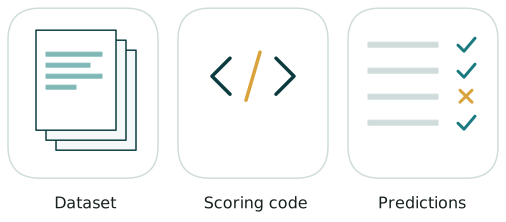
An open benchmark for OCR on low-resource scripts. We report character error rate for each script separately instead of one average. The dataset, the scoring code and all prediction files will be public, including the pages where we do badly. We'll also report results on established public benchmarks, so Rune can be compared with other systems.

Releasing with Rune-1

Follow on GitHub
RuneBench publishes three things: the dataset, the scoring code, and every prediction, including the wrong ones.

Test the API while Rune-1 trains

The endpoint Rune-1 will use is live now, with three preview models. Build against it today; moving to Rune-1 later means changing the model name.

  • 5 free pages a day at runemic.com/try, no sign-up
  • Sign in for $5 of free credit, no card needed
  • Compare up to three models, and get an API key with cURL, Python and JavaScript examples
# one page in, Markdown out
curl https://api.runemic.com/v1/ocr \
  -H "Authorization: Bearer $RUNEMIC_KEY" \
  -F "file=@page.png"

# → { "text": "# Invoice No. 4821 …",
    "usage": { "cost_usd": 0.002 } }